Crime & Law
As Trump Threatens to Send National Guard to Chicago, Public Safety Experts Weigh in on Crime Data and Public Spending
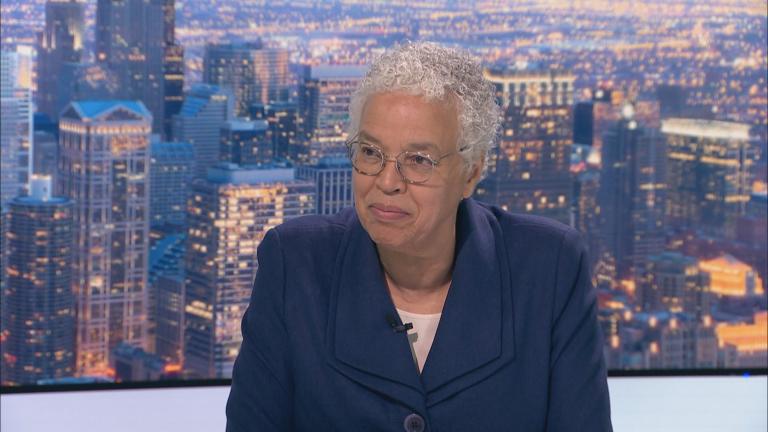
Video: Joining “Chicago Tonight” are University of Chicago associate professor Aaron Gottlieb, who runs the Resource Allocation Lab; University of Illinois Chicago assistant professor Kathryn Bocanegra; David Olson, a Loyola University Chicago professor who is co-director of Loyola’s Interdisciplinary Center for Criminal Justice Research; and Michael Negron, senior fellow for economic opportunity at the Center for American Progress. (Produced by Bridgette Adu-Wadier and Abena Bediako)
President Donald Trump’s crackdown on crime in Washington, D.C., may be making its way to Chicago.
The president is threatening to deploy the National Guard, saying crime is out of control and that he doesn’t believe reports that violence is down, despite statistics to the contrary.
Chicago Police Department data shows that compared to last year, violent crime in the city is down 22% through the end of July. There have been 36% fewer shootings, and homicides are down 32%.
“The important thing about looking at crime and levels of crime is even if crime levels are down, if the public’s perception is that it isn’t, it may not matter,” said David Olsen, professor and co-director of the Center for Criminal Justice at Loyola University Chicago. “In the case of Chicago and Illinois, for the most serious crimes, homicides and shootings, those crimes tend to get reported the most by the public, but we also have other sources to gauge whether those trends are consistent.”
The Chicago Police Department annually tracks violent crime and all crime throughout the city, and the city updates its violence reduction dashboard that provides a statistic of the safety gap.
“The rates of violence victimization across communities has been unequal,” said Kathryn Bocangegra, assistant professor at University of Illinois Chicago’s James Addams School of Social Work. “The burden of violence and victimization has been borne by Black and Latino communities. When you look at those accurate statistics, I think it’s important to ask the questions of those at the epicenter of violence, who feel it most acutely if they are experiencing those reductions.”
Bocanegra said the dashboard is currently showing greater gains in public safety, which experts say should not just be defined by the criminal legal system but under a larger scope.
“We need to expand the way we think of public safety,” said Aaron Gottlieb, associate professor at University of Chicago’s Crown Family School of Social Work, Policy, and Practice. “It’s not just homicide or crime, it’s public health, it’s education, it’s people’s ability to get a job. These are all things that we should be thinking about when we make decisions.”
Gottlieb is also the principal investigator at the Resource Allocation Lab, which recently published a study focused on the impact of shifting funding away from the criminal legal system to other systems.
“We see that these kind of investments and making sure we have enough resources to go towards things like health and education have the potential to reduce suicide in a way that’s pretty substantial,” Gottlieb said. “I would love our budget discussions about reallocating resources to take a more holistic view of what that means and for policymakers and communities to make decisions with full information.”
City and state officials agree a more holistic approach to addressing public safety is needed.
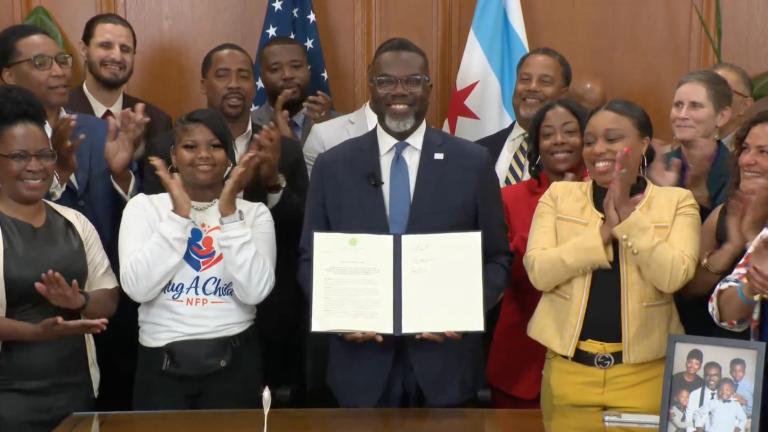
Mayor Brandon Johnson has said that in order to bring down crime, more needs to be done to address systemic inequities in certain neighborhoods. He and Gov. JB Pritzker remain adamant that the presence of the National Guard in Chicago will offer no positive outcomes.
“What the (Trump) administration is doing right now is not going to contribute to public safety based on what we’ve seen in Washington, where we have National Guardsmen in the tourist areas and not in the communities where there is actually a crime issue,” said Michael Negron, senior fellow for economic opportunity at the Center for American Progress.
Negron said when looking at economic development and a stronger economy it’s important to remember business community consumers look for public safety, stability and predictability in policymaking.
“Retailers are reporting less foot traffic,” Negron said. “Restaurant reservations are quite down. We are seeing some earlier bad indicators of business activity.”
Negron noted the National Guard deployment to California had a significant impact on the state’s economy and argued the tactic is not a good use of public money.
Pritzker said in a news conference Monday, “...Calling the military into a U.S. city to invade our streets and neighborhoods and disrupt the lives of everyday people is an extraordinary action and it should require an extraordinary justification.”
Note: This article has been updated to correct a quote from Aaron Gottlieb.
WTTW News coverage of policing and police reform is supported by The Joyce Foundation.